“People don’t buy what you do; they buy why you do it.” – Simon Sinek (adapted to interviews: great candidates don’t just list skills. They tell stories that show why they’re the right fit.)
Imagine this: A nervous candidate sits across from the hiring manager, fumbling through a behavioral question. Their answer jumps around, mixes “we” with vague details, and ends without any real impact. Then, after practicing the STAR method, the same person returns for a follow-up round. This time, their response flows naturally: a clear setup, their specific role, decisive actions, and a measurable win that leaves the interviewer nodding. I’ve witnessed this transformation countless times. People who once struggled to articulate their experiences suddenly sound confident, compelling, and ready for the role.
The STAR method isn’t a rigid script. It’s a flexible framework that provides natural flow to your stories, making them more engaging and memorable. Whether you’re gearing up for your next job interview or simply want to sharpen your communication skills, let’s explore STAR in depth, its roots, the psychology behind it, and some quick alternatives for comparison.
The Origins and Evolution of the STAR Method
The STAR method emerged in the 1970s as part of the rise of behavioral interviewing techniques. Pioneered in 1974 by industrial psychologist Dr. William C. Byham, it was designed to shift interviews away from hypothetical “what would you do” questions toward real, evidence-based examples from a candidate’s past.
Over the decades, STAR has grown from a specialized tool into a global standard for job preparation. It’s widely recognized for helping predict future performance more reliably than traditional methods. In practice, it’s proven to build confidence, reduce rambling, and turn everyday experiences into powerful narratives.
Breaking Down the STAR Framework
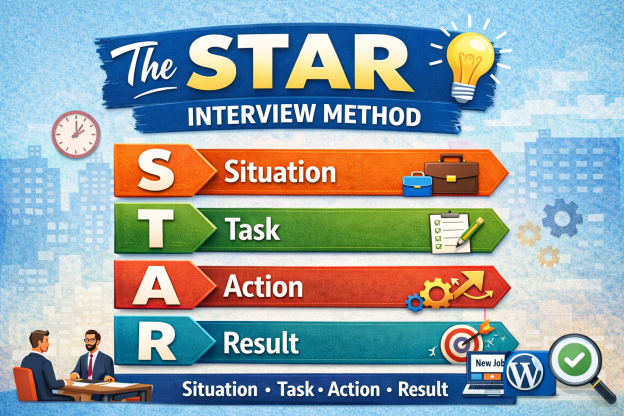
At its core, STAR stands for Situation, Task, Action, Result. It’s built to answer behavioral questions (starting with “Tell me about a time when…”) in a structured, easy-to-follow way and particularly useful in software engineering interviews where you need to showcase problem-solving, technical decision-making, and impact.
A strong response typically divides like this:
- Situation (15-20%): Set the scene quickly with relevant technical context. Include the project, tech stack, team dynamics, or constraints. Enough to hook the listener without excess detail. Example: “In my role as a backend engineer at a fintech startup, our production API was experiencing intermittent failures during peak hours, causing increased latency and error rates for thousands of users.”
- Task (10%): Define your specific responsibility or goal. Keep it concise and focused on your ownership. Example: “As the lead on the API team, my task was to diagnose the root cause and implement a fix within 48 hours to prevent SLA violations.”
- Action (50-60%): The heart of your story! Detail the technical steps you took. Use “I” statements to highlight your contributions, decisions, debugging process, code changes, tools used, and trade-offs. This is where you demonstrate engineering skills like debugging, optimization, refactoring, or architectural choices. Avoid “we” to keep the focus on your impact. Example: “I first reproduced the issue in a staging environment using distributed tracing tools like Jaeger and analyzed logs in ELK stack to identify a race condition in our caching layer. I then profiled the service with flame graphs, pinpointed the bottleneck in a third-party library integration, and refactored the code to use asynchronous processing with Redis queues. I also wrote unit and integration tests, ran load tests with Locust to validate the fix under simulated traffic, and coordinated a hotfix deployment via CI/CD pipeline with zero-downtime rolling updates.”
- Result (10-25%): Close with the outcome. Quantify achievements with metrics (e.g., latency reduction, error rate drop, performance gains) and note learnings or broader impact. Example: “The fix reduced average latency by 65% and dropped 5xx errors from 12% to under 0.1%, restoring user trust and preventing potential revenue loss. The team adopted the new tracing practices, and I documented the incident for our post-mortem playbook, which has helped us resolve similar issues 40% faster since.”
Aim for 1-2 minutes total. This keeps answers focused yet complete, turning potential ramble into a polished, technically impressive story that resonates with engineering managers and tech leads.
The Science and Psychology Behind STAR
Though not tied to one landmark study, STAR draws from established principles in behavioral and cognitive psychology:
- Behavioral Consistency: Past behavior predicts future performance. This is a cornerstone of industrial-organizational psychology. STAR pulls real examples, avoiding hypotheticals.
- Cognitive Load Reduction: Neuroscience shows brains process info in “chunks.” STAR’s four steps align with this, easing recall under pressure and helping interviewers follow along.
- Narrative Psychology: Well-structured stories release dopamine and oxytocin, boosting engagement and empathy. STAR turns answers into mini-narratives with clear arcs.
- Bias Mitigation and Objective Data: The format gathers concrete evidence on skills, reducing reliance on impressions or biases like the halo effect. It also reveals self-awareness through reflection.
These foundations make STAR effective for candidates and interviewers alike.
Modern Extensions and Variations
STAR remains flexible. Add a “T” for Takeaways to create START, explicitly linking lessons to the target role for relevance. Hiring Managers want to know that you are a constant learner. You thoughtfully reflect and improve from the previous experience.
CARL (Context, Action, Result, Learned) adds deeper reflection, suiting growth-focused positions.
STAR Practice Exercises: Put It Into Action
Mastery comes from practice. Here’s a proven routine from training sessions:
- Build Your Story Bank – List 6-10 real examples from work, projects, volunteering, or school. Categorize by theme (leadership, teamwork, problem-solving). Bullet out Situation, Task, Action, Result for each.
- Practice Out Loud – Record answers on your phone (60-90 seconds). Review: Strong “I” focus? Action dominant? Quantified results? Edit and retry.
- Mock Interviews – Practice with a friend, mentor, or platforms like Pramp. Get feedback on clarity and engagement.
- Adapt Stories – Reuse one example for multiple questions (e.g., same project for leadership, adaptability, conflict).
Try these 8 common questions. Outline STAR responses on paper, then speak them aloud:
- Tell me about a time you worked as part of a team to successfully complete a project.
- Describe a time when you faced a difficult problem at work. How did you solve it?
- Give an example of a time you had to handle conflict with a colleague or team member.
- Tell me about a time you worked under significant pressure or a tight deadline.
- Describe a situation where you demonstrated leadership skills.
- Tell me about a time you made a mistake. How did you handle it and what did you learn?
- Give an example of when you had to adapt to a major change at work.
- Describe a time you set a challenging goal and achieved it.
Bonus: End each with a Takeaway tying it to your next role.
Start with comfortable stories, then tackle tougher ones like failures.
Quick Alternatives to STAR and a Head-to-Head Comparison
STAR is versatile, but alternatives add variety:
- CAR (Context, Action, Result): Merges Situation/Task for brevity. This is great for quick interviews.
- PAR (Problem, Action, Result): Leads with the issue. This is ideal for problem-solving roles.
- SOAR (Situation, Obstacle, Action, Result): Spotlights challenges. This is perfect for resilience-focused jobs.
Comparison table:
| Framework | Key Strengths | Best For | Drawbacks |
|---|---|---|---|
| STAR | Balanced, emphasizes role/actions, beginner-friendly. | General behavioral questions; building confidence. | Can feel formulaic if over-practiced. |
| CAR | Streamlined (3 steps), fast-paced. | Time-limited interviews; concise styles. | Less focus on specific task. |
| PAR | Problem-first, dynamic. | Management/analytical roles. | May skip helpful context. |
| SOAR | Highlights obstacles, shows adaptability. | High-pressure/sales/startup positions. | Slightly longer answers. |
| CARL | Adds reflection depth. | Leadership/growth-oriented jobs. | Requires strong self-awareness. |
STAR stands out as the most reliable starting point. It is simple, comprehensive, and time-tested. Blend in alternatives to stay fresh.
Ready to transform your interviews? Practice these exercises and share your progress or favorite stories. Let’s connect!
Insights drawn from behavioral interviewing best practices and career development resources.
References
- The STAR method: How to make your interview stories shine – LinkedIn (Carly Agar).
- 10 Storytelling Interview Questions With Sample Answers – Indeed.com.
- STAR Method: How to Use This Technique to Ace Your Next Job Interview – TheMuse.com.
- The Power of Storytelling: Using the STAR Method in Interviews – PatchStaffing.com.
- How to practice the STAR method for situational interview questions? – Reddit.com.
- How to Answer Behavioral Interview Questions Using The STAR Method – Career.PennWest.edu.
- Strengthen Your Interview Skills: How to Craft a Compelling Story of Impact – TeachForAmerica.org.
- STAR Method is not best for answering behavioral interview questions. – LinkedIn (Madeline Mann).
- STAR Interview Questions: What They Are + How to Answer Them – Coursera.org.
- Use the STAR Interview Method to Land Your Next Job – YouTube.
- 5 Quotes That Teach You Everything You Need To Know About Leadership Storytelling – Forbes.com.
- 23 Inspirational Storytelling Quotes – StoryLab.co.
- Core 4 Stories for Behavioral Based Job Interviews – RealisticRecruiting.Beehiiv.com.
- 43 Beautiful Quotes about Storytelling – LinkedIn (Chris Walker).
- Crush Your Interviews with the Power of Storytelling – ScarletInk.com.
- The Power of Storytelling in Job Interviews: Stand Out from the Crowd – YouTube.
- “Why good storytelling helps you stand out in a job interview” – AmpdCareers.com.
- Let’s pragmatically get better at behavioral interviews (and storytelling)! – TanayAgrawal.Substack.com.
- “Stories & Examples During Interviews” – Reddit.com.
- How to establish credibility through storytelling in a job interview – Quora.com.
- The Problem with the STAR Method – Where It Came From and Why It Fails Today – LinkedIn.
- STAR Method for Interviewing and Feedback – DDI.com.
- Situation, task, action, result – Wikipedia.org.
- “Alternative to star method for job applications” – Facebook.com.
- When did the STAR interview format start becoming a standard for bullshit jobs? – Reddit.com (r/antiwork).
- About DDI History | Leadership Assessment & Development – DDI.com.
- STAR+E: An Undergraduate Teaching Strategy to Make the STAR Model Stick – Community.NACEweb.org.
- Mastering Behavioral Interviewing with STAR Story Bank: A Guide – CourseHero.com.
- Development Dimensions International History: Founding, Timeline, and Milestones – Zippia.com.
- Assessment Center Structure and Construct Validity: A New Hope – SciSpace.com.