

Separating fact from fear — how ATS really works, who uses it, what it costs, and how to make it work for you.
10 min read
If you’ve applied for jobs online recently, you’ve almost certainly encountered an applicant tracking system (ATS) — whether you knew it or not. ATS platforms have become the backbone of modern recruiting, yet widespread misconceptions about how they work have spawned an entire cottage industry of “ATS-beating” advice. Here’s what’s really going on.
What Is an Applicant Tracking System (ATS), and What’s the “Score”?
An Applicant Tracking System is software that companies use to manage job applications end-to-end: posting openings, collecting resumes, screening candidates, and tracking them through the hiring pipeline. Vendors like Workday, Taleo, Greenhouse, and Lever each offer different levels of sophistication.
Some of these platforms assign a “fit score” or “match score” — a ranking based on how closely your resume aligns with the job description. This is typically calculated using keyword matching (skills, titles, experience terms), formatting compatibility, and sometimes more advanced contextual analysis. But here’s the important part: this score is a starting point for recruiters, not a verdict.
ATS scoring is designed to help recruiters prioritize applications — not to make final hiring decisions. Humans are still doing the actual screening in the vast majority of cases.
Does Every Company Use an Applicant Tracking System?
No. ATS adoption is extremely common among larger organizations but far from universal. Usage varies dramatically by company size and industry.
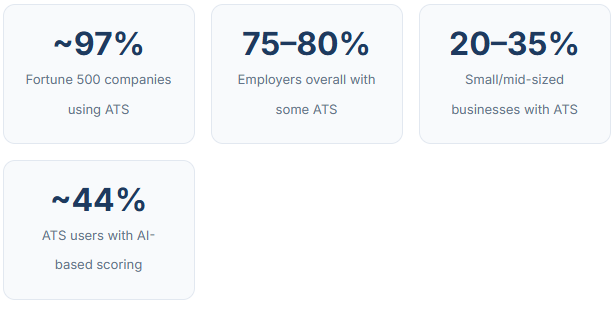
~97% Fortune 500 companies using ATS
75–80% Employers overall with some ATS
20–35% Small/mid-sized businesses with ATS
~44% ATS users with AI-based scoring
Smaller companies and startups frequently rely on email, spreadsheets, Google Forms, or simply reviewing applications manually. Many don’t have dedicated HR teams, and if they’re only hiring one or two people a year, the overhead of even a cheap ATS can feel unnecessary.
Can Every Company Afford One?
The barrier to entry has dropped significantly. Cloud-based SaaS models, freemium tiers, and pay-as-you-go pricing mean that even bootstrapped startups can technically access basic ATS features. Plans start as low as $15–19/month for tools like JuggleHire or Manatal, with free tiers available from Zoho Recruit and Breezy HR. Mid-sized companies typically spend $100–500/month, while large enterprises invest $15,000–100,000+ annually on comprehensive platforms.
So affordability isn’t the main barrier anymore — desire is. Many small businesses simply don’t see the value when their hiring volume is low and manual processes work fine. Adoption among SMBs is growing as prices fall, but it’s still far from universal.
The AI/ML Myth: Is a Robot Rejecting Your Resume?
This is where the biggest disconnect lives. Many job seekers (and plenty of career coaches selling resume services) treat ATS as an all-powerful AI gatekeeper — imagining algorithms silently auto-rejecting resumes before a human ever sees them. The reality is considerably less dramatic.
Yes, about 79–83% of ATS platforms now incorporate some automation features like context parsing or fit prediction. But in practice, AI ranks and flags candidates as a starting point. According to recruiter surveys, humans handle the actual screening and rejection decisions in 92–100% of cases. Only around 8% of companies use true auto-rejection based on scores, and even then it’s typically for basic disqualifiers like missing required certifications — not nuanced judgment calls.
Why the myth persists
Resume-writing services profit from selling “ATS-beating” tips. Viral social media horror stories amplify fear. And confusion about how ATS parsing actually works — combined with the frustrating reality that most applications simply go unanswered — makes it easy to blame an invisible algorithm. The truth is that recruiters are overwhelmed with volume, not that robots are conspiring against you.
The Real Bottleneck: Volume and Timing
Here’s a more accurate picture of what happens to your application. The average job posting receives 100–250 applications. Recruiters typically review only the top 10–20% in any detail, interview a handful (often 3–7 candidates), and move on. The remaining 80–90% aren’t necessarily “rejected by AI” — they’re deprioritized because interview slots filled before anyone got to them.
Timing matters more than most people realize. Applying within the first few days of a posting significantly increases your visibility, as some systems flag fresh applications and recruiters for urgent roles may close their search quickly. That said, ATS doesn’t always sort chronologically — a strong late applicant with an excellent keyword match can still surface near the top of a relevance-ranked list.
8 Practical Pointers for Applicant Tracking System (ATS) Optimization
Whether you’re a junior developer or a senior engineer, these fundamentals will help your resume surface in any ATS without resorting to gimmicks.
- Tailor keywords from the job description. Extract exact terms — specific technologies, frameworks, methodologies, and titles — and weave them naturally into your summary, skills section, and experience bullets. Match the language the employer uses.
- Use a clean, simple format. Stick to a single-column, reverse-chronological layout with standard section headings: Professional Summary, Skills, Work Experience, Education, Projects. Avoid tables, multi-column layouts, graphics, icons, and images that break ATS parsing.
- Choose ATS-friendly fonts and file types. Use standard fonts (Arial, Calibri, Times New Roman) at 10–12pt. Submit as .docx unless the posting specifies PDF. Name your file clearly: FirstLast_Role_Resume.docx.
- Build a dedicated skills section near the top. List relevant hard skills (languages, tools, platforms) and soft skills in a scannable format. Include acronyms and full forms where relevant (e.g., “CI/CD” and “Continuous Integration/Continuous Deployment”).
- Embed keywords in context, not just lists. ATS often scores higher when keywords appear within full sentences and achievement descriptions, not only in a standalone skills block. Repeat important terms across sections naturally.
- Lead with quantifiable achievements. Use action verbs and metrics: “Developed scalable backend services in Node.js, reducing API latency by 40%” beats “Responsible for backend development.” This helps both ATS matching and human reviewers.
- Keep it concise and standardized. One page for most roles, two pages maximum for senior positions. Use standard headings, avoid headers/footers containing critical information, and skip unusual symbols or creative formatting.
- Test your resume before submitting. Upload to free ATS scanners like Jobscan, Resume Worded, or Rezi. Fix parsing issues (missing text, jumbled sections) and aim for a strong match score against the specific job description.
For Senior and Leadership Roles: Adjusting the Skills Balance
If you’re targeting Staff Engineer, Director of Engineering, VP of Technology, or similar positions, the same ATS fundamentals apply — but the content of your skills section needs to shift significantly.
The Hard/Soft Skill Balance at Senior Levels
At leadership levels, aim for roughly 8–12 high-impact skills split approximately 40–60% technical and 40–60% leadership. Hard skills prove you still have technical credibility and can guide architecture decisions. Soft/leadership skills demonstrate you can lead organizations, drive strategy, and influence cross-functionally — which is where senior-level impact is actually measured.
Technical / Hard Skills
- System Design & Architecture
- Cloud Platforms (AWS/GCP/Azure)
- Microservices & Distributed Systems
- DevOps & CI/CD Pipelines
- Scalability & Performance
- Technical Roadmapping
Leadership / Soft Skills
- Engineering Team Leadership
- People Management & Mentoring
- Strategic Vision & Execution
- Cross-Functional Collaboration
- Stakeholder Engagement
- Budget & Resource Management
Key: Don’t just list leadership skills — demonstrate them in your experience bullets with measurable outcomes. “Led 50+ engineer organization to deliver 3x faster release cycles through process redesign” reinforces both the keyword match and the human impact.
The Bottom Line
ATS is a volume-management tool, not an infallible judge. It helps overwhelmed recruiters sort through hundreds of applications, but humans still make the real decisions. Tailor your resume per application, use clean formatting, front-load relevant keywords, and apply early when possible. And remember: networking and referrals often bypass ATS entirely — landing you straight in the pile that actually gets read. Don’t buy into the AI conspiracy. Focus on strong content, smart targeting, and making real connections. Related: Imposter Syndrome? Here’s How to Thrive Anyway.